-

- sales@3phis.com
- +86 571-88092836

Industry 4.0, China's intelligent manufacturing
Industry 4.0 has arrived. Some predict that it will eliminate all traditional industries within 10 years and cause a great revolution in social life. Germany, the first to propose this concept, led the fourth industrial revolution (Industry 4.0) and sparked a new wave of industrial revolution worldwide. So, what fate will China's manufacturing face in this wave of change?
Industry 4.0 was first proposed by Germany. After the financial crisis, almost all developed countries' economies were sluggish, but Germany relied on manufacturing, which not only had low unemployment rates but also grew rapidly, making the German government realize that manufacturing is an indispensable pillar of its economic growth. In April 2013, the German government launched the "Recommendations for Implementing the Industry 4.0 Strategy to Ensure the Future of German Manufacturing". Subsequently, countries around the world paid close attention and began to compete for the discourse power of manufacturing: the United States launched the "Industrial Internet" strategy in December 2014, connecting virtual networks with entities to form a more efficient production system; Japan launched the "New Robot Strategy" on January 23, 2015; France proposed the "New Industry France" plan; and China also introduced the "Made in China 2025" ten-year strategic plan in 2015.
As we all know, the first industrial revolution (Industry 1.0) occurred in England, which was driven by steam and mechanization; the second industrial revolution (Industry 2.0) was driven by electricity and mass production; the third industrial revolution (Industry 3.0) was driven by electronic information technology and automation; and the fourth industrial revolution (Industry 4.0) is called intelligentization. In the era of Industry 1.0, 2.0 to 3.0, the five modules of raw materials, machinery and equipment, factories, transportation, and sales were fixed and indispensable. However, "Industry 4.0" is to improve the level of manufacturing by applying new technologies such as the Internet of Things and intelligentization, and to transform manufacturing towards intelligence, realizing real-time management through network technology that determines the production process. Its "bottom-up" production mode revolution not only saves innovative technology, costs, and time, but also has the potential and opportunity to cultivate new markets.
Industry 4.0 has a key point, which is that "raw materials (substances)" = "information". Specifically, the raw materials purchased by the factory are "tagged": this is the XX product produced for customer A, and the raw materials used in the XX process. To be precise, it is the "raw material" with information used in smart factories that realizes
Since the reform and opening up, China has developed into an industrial powerhouse and its manufacturing industry occupies an important position in the global supply chain. By 2010, China's manufacturing industry had surpassed the United States, becoming the world's largest. As emerging economies with lower cost advantages rapidly rise and join the competition, some of our country's production enterprises, which mainly engage in contract manufacturing, face tremendous survival pressure. Since 2014, some processing and manufacturing enterprises in the southeastern coastal areas have closed down, which may trigger a chain reaction of other manufacturing enterprises closing down in other regions. At the same time, many developed countries are reflecting on the problem of "hollowing out" of their manufacturing industries and actively promoting new manufacturing development strategies. These factors are putting high pressure on China's manufacturing industry, which is facing the dual squeeze of domestic and foreign pressures. Therefore, the transformation and upgrading of China's manufacturing industry is imperative.
If we follow the standards of Germany's Industry 4.0, China's industrial mainstay is still in the stage of "learning version 2.0, popularizing 3.0, and at the same time developing towards 4.0". Most developed countries have already developed to the stage of Industry 3.0. The process of transforming from an industrial powerhouse to an industrial power is essentially the process of promoting industrial modernization, and the core task of China's industrial power strategy is to promote the process of industrial modernization in our country. In the later stage of industrialization, manufacturing is equally valued, with more emphasis on "quality" and "strength". Relying on traditional methods that consume a large amount of material resources is no longer sustainable. Only by transforming the development of industry can we adapt to the needs of the new stage of economic development. While popularizing Industry 3.0, we also need to use the concept of Industry 4.0 to transform traditional industries and develop new industries and business models. Since 2015, the State Council has successively issued a series of top-level design documents such as "Made in China 2025", "Opinions on Vigorously Promoting Mass Entrepreneurship and Innovation", and "Guiding Opinions on Actively Promoting the 'Internet Plus' Action", which have laid the groundwork for the transformation and upgrading of China's traditional industry and the search for new growth drivers.
"Intelligent Manufacturing" is considered to be the core of the future industrial transformation. The direction of China's manufacturing industry transformation and upgrading is towards manufacturing informatization, specifically in the direction of digitization and intelligence. The development direction of intelligent manufacturing not only means an increase in the degree of intelligence but should also be more in line with consumer needs. In the past, manufacturing was characterized by large quantities and low costs. In the future, intelligent manufacturing can coordinate to solve consumers' demands for low cost, high quality, and personalization. Perhaps, with the rapid rise in labor costs, the promotion of new technological and industrial revolutions, and the transformation and upgrading of the industrial structure, robots will add impetus to "intelligent manufacturing". At present, China's robot industry is developing rapidly, and the design technology of industrial robots has basically matured. Pioneering enterprises have embarked on the path of independent development, and the service robot industry is also incubating.
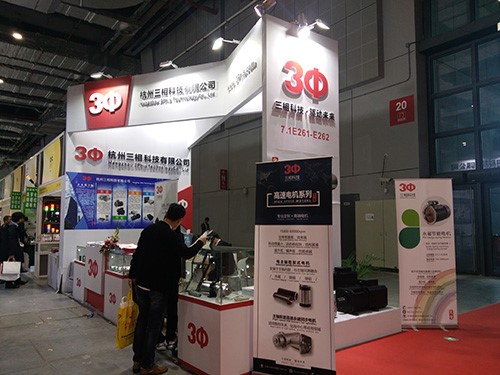
On November 7, 2017, Hangzhou Three Phases Technology Co., Ltd. ., which is committed to providing high-quality and efficient motor products for production and life, made its debut at the 19th China International Industry Fair, showing its extraordinary quality.

Recently, Hangzhou 3phis technology, a high-end high-speed integrated motor import substitution company, announced that it has successively completed A and A+ rounds of tens of millions of RMB financing. The investment was led by Country Garden Venture Capital and Liyuan Venture Capital, followed by Yingdong Capital. Previously, it has received angel round investment from Oufang Angel and Angel Bay Venture Capital. Huaxing Alpha acted as the exclusive financial advisor for this financing. This round of financing will be used for technology research and development, market expansion and talent reserve.
